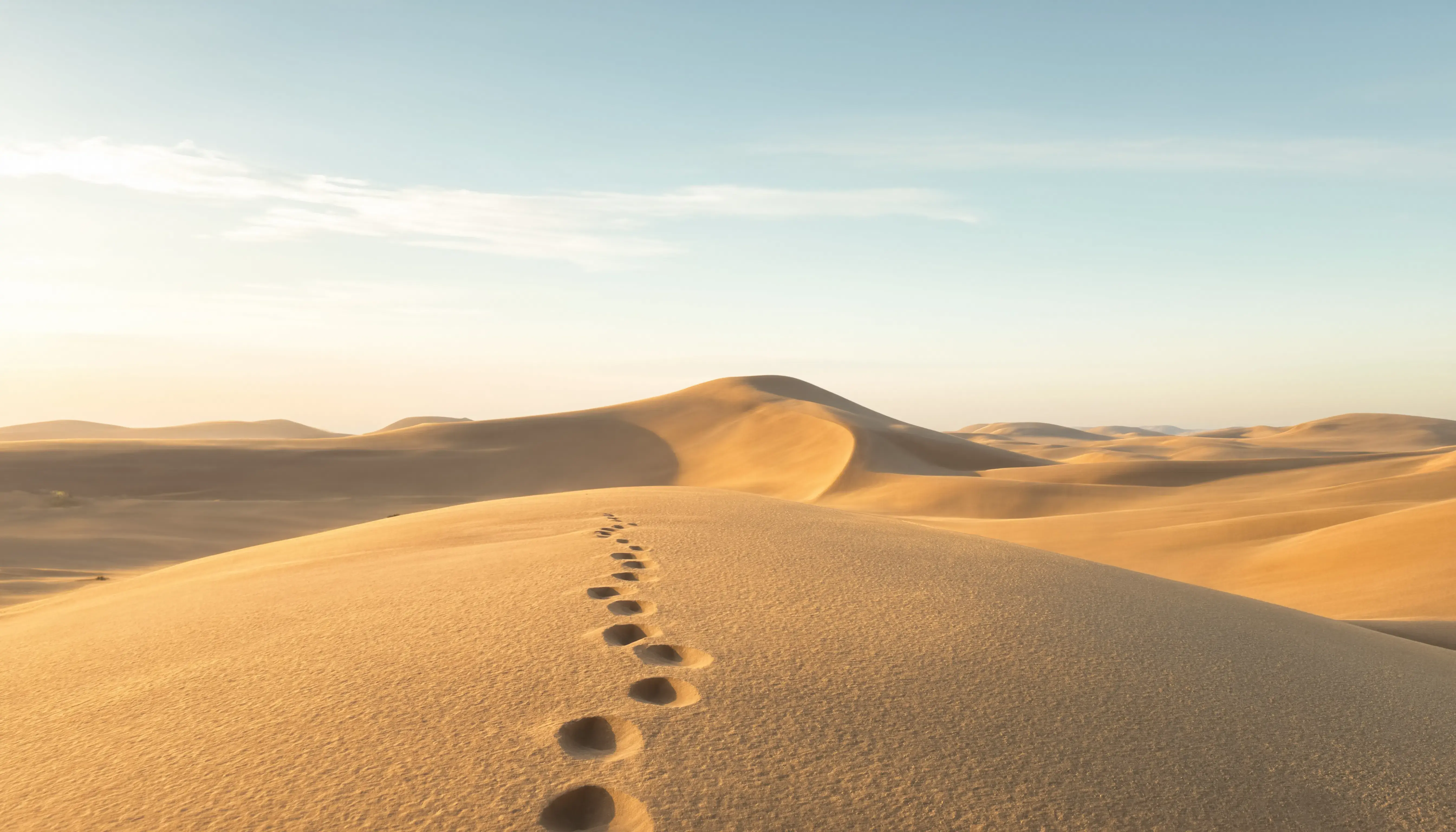
Solitude and Desert Expanse
The desert has a way of simplifying everything.
It strips away distractions. It removes the familiar landmarks we rely on to orient ourselves. It challenges our understanding of distance, scale, and even time itself.
Standing in the Namib for the first time, I was struck by how little there was to see.
And yet, somehow, it felt like the most visually overwhelming place I had ever encountered.
The horizon stretched endlessly in every direction. Towering dunes rose from the earth like ancient monuments. The wind moved slowly across the sand, redrawing the landscape grain by grain. There was no soundtrack beyond the occasional gust of air and the soft crunch of footsteps disappearing almost as quickly as they appeared.
The assignment from Terra Journal was straightforward: document the landscape and the communities that exist within it.
What emerged was something far more personal.
Over the course of a week, I traveled through remote regions of the Namib Desert, often driving for hours without seeing another vehicle. Entire mornings passed in silence. There were moments when the sheer scale of the environment felt difficult to comprehend. Distances became deceptive. Objects that appeared nearby required hours of travel to reach. Shadows shifted slowly across dunes that had remained unchanged for centuries.
The desert seemed to operate on a different timeline.
A slower one.
A more patient one.
Photographically, the challenge was not finding subjects but understanding them. The desert offers very little in terms of obvious visual complexity. There are no crowded streets, no dramatic architecture, and few of the familiar elements that naturally attract attention.
Instead, the landscape rewards observation.
Small details become significant.
The curve of a dune illuminated by early morning light. The texture left behind by wind moving across the surface. A solitary acacia tree surviving against impossible odds. The faint traces of movement crossing an otherwise untouched expanse of sand.
Each detail felt amplified by the surrounding emptiness.
One morning, before sunrise, I climbed a dune overlooking a vast valley of shifting sand. The climb itself took nearly an hour. By the time I reached the summit, the world below remained hidden in darkness. Then, gradually, the first light appeared.
The transformation was extraordinary.
Shadows stretched across the landscape, creating abstract patterns of light and form. Colors shifted from deep blue to soft gold. The dunes seemed less like geological formations and more like sculptures shaped by centuries of wind.
For several minutes, there was no movement anywhere in sight.
Only light.
Only space.
Only silence.
It remains one of the most profound photographic experiences I have ever had.
Throughout the project, I found myself thinking about solitude. In many contexts, solitude is portrayed as something to overcome. A condition to escape.
The desert offered a different perspective.
Here, solitude felt expansive rather than restrictive.
It created room for reflection.
Room for observation.
Room to notice things that might otherwise go unseen.
The images in this series are not intended to document isolation as loneliness. Instead, they explore solitude as a form of connection—a way of becoming more aware of the environment, of time, and of one's place within a much larger landscape.
As the days passed, human presence appeared only occasionally. A distant traveler crossing the dunes. A small settlement at the edge of the desert. A solitary road cutting through the terrain before disappearing into the horizon.
These moments became some of the most powerful images of the project.
Not because they dominated the landscape, but because they emphasized its scale.
The desert always remained larger.
Older.
More enduring.
Looking back, Solitude and Desert Expanse became less about geography and more about perspective. It is a study of scale, stillness, and the emotional impact of vast open spaces. It asks what happens when we remove the noise of everyday life and place ourselves within an environment that demands patience and humility.
The answers are different for everyone.
For me, they were found somewhere between the dunes and the horizon.
In the silence.
In the distance.
And in the extraordinary beauty of a landscape that asks for nothing except your attention.
More Stories
Lofoten Islands, Norway
Northern Atlas Magazine
Copenhagen, Denmark
Aurelia Studio